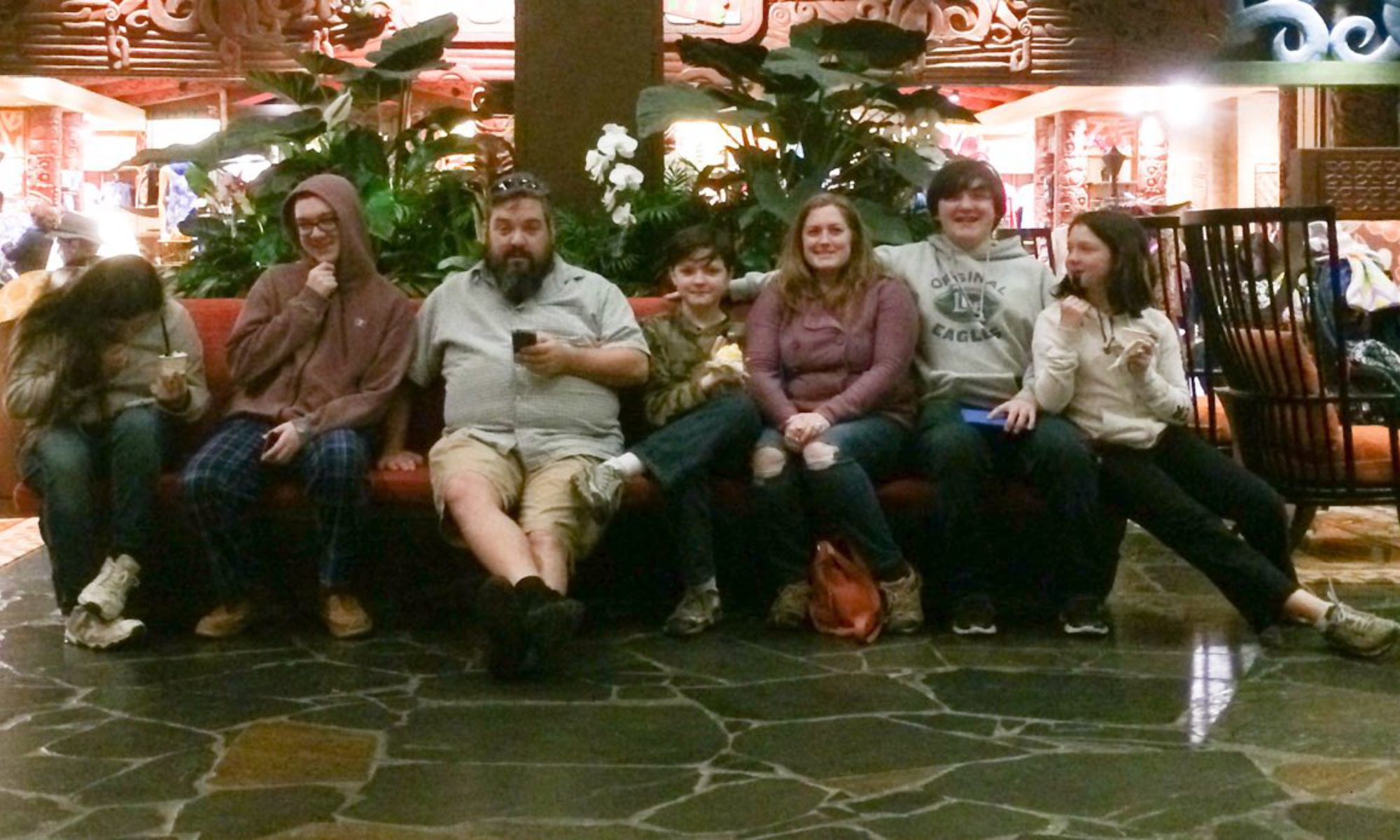
Anticipation

A few days before we left for Tokyo, a friend emailed and asked if I was ready for the trip. All of us – myself, my husband Tom, and our five children, ages six to six months, would be away from home for 27 days. I had only found when and for how long about two weeks prior to departure.

Beyond passports, everything else had to be packed at last minute as we were wearing most of the clothes that we were bringing. It felt like someone had casually spited me by asking, “Do you have all your Christmas shopping done?” on Christmas Eve.

“No. But, we’re going whether we’re ready or not,” I said.

There’s no stopping Christmas.

In the months prior to our trip, Tom had traveled so much that our children were getting emotionally distraught. He had been gone about one to two weeks out of every month since Leah was born in September.

One night, after Tom’s being gone for many days, I awoke at about two o’clock in the morning to hear the sound of furniture being pushed around upstairs and my four year old daughter crying loudly. I grabbed my oval tortoiseshell glasses from my nightstand and stumbled out of bed. My heart raced. I didn’t know what to expect. Was someone in her room? Why was she crying? There was Tabitha, standing on top of her toy box, writing “Der Dad, I mis U Love Tab” in the breath marks on her window pane. I scooped her up gave her a big hug.

“I just miss daddy so much!” she sobbed. She was having trouble catching her breath and was gasping in between each of her words, she was crying so hard.

“Me too, Tab.”

I carried her to her bed and sat on the edge, holding her on my lap several minutes. She buried her face in my nightshirt. Her tears and runny nose made her dark, shoulder length hair stick to her face. I kept trying to pull aside the strands without much luck.

“Try to get a hold of yourself, honey. I know you’re really sad. Mommy’s really sad, too,” I said, trying to comfort her. “But let’s try to be brave. We don’t wake up the rest of the kids, okay?”

She smeared away the tears with her little fists.

“Okay, but can I sleep in your bed?” she asked . “Pleeeease?”

Normally, I’m the kind of insensitive mom that flatly tells kids ‘No’ when they ask to sleep in my bed. On the rare occasion someone has a fever and lands themselves the coveted spot in mommy and daddy’s bed, I change into a most horrible, dysfunctional grouch by morning. The children know better than to turn mommy into this monster, and involuntary night terrors aside, they usually steer clear. I just can’t relax enough to sleep soundly. I’m always worried they’ll fall off or that we’ll all wake up in a puddle of pee. Often times, they don’t sleep anyway – they just lay awake and make comments about the shadows on my wall from the pine trees or they find it hilarious and impossible to control their laughter over the fact that they can smell daddy’s feet if they pull the covers over their heads. Then, fever or no fever, they are sent back to their own bed. With all of the five kids either having ear infections, strep throat or both in the past month, there had been a lot of fevers lately.

But, tonight was different. I couldn’t say ‘No’ and – my excuse for being cramped was absent – in Japan, in fact.

I pulled my olive green microsuede quilt up to her chin and snuggled up beside her. “So what made you think to write ‘Dear Dad I miss you’ on your window?

Tab perked up a bit.

“You know in the Fievel movie?”

“American Tail, yeah…”

“Well, Fievel could see the moon and his dad could see the moon, too,” she explained. “So, I wrote my message on the window because the moon was shining through and so dad should be able to get my message, right?”

The tooth fairy isn’t real and daddy wasn’t reading her message.

“Um, you know what? We can show dad your moon-message when he gets back in a few days,” I said. “We won’t wash that window when we clean your room, okay?”

She hugged herself at the thought.

“You know, Tab,” I said, “Even though we can’t see daddy right now, do you know can see both daddy AND your message AND you and me all at the same time?”

“God?”

“Yes. So we can ask God to take care of daddy while he is in Japan and to comfort daddy because I know daddy misses us to.” I took my daughter’s hands in mine and we prayed for Tom.

For once Tabitha stayed dry through the night, and I admit, I was comforted to have her there, too.

When Tom called the next day to see how I was doing, I wasn’t so brave. I was cleaning Tabitha’s room when the phone rang. I was staring at her message.

“I’m a wreck,” I said. “We’re all wrecks, actually.” The tension in my voice was growing. “I had to comfort a depressed four year old last night and I spent $350 in pediatrician copays this week. They’re all still sick! Why are you even coming home? You leave for your next trip four days after you get here. You’ll still be lagged – you’ll be sleeping the whole time you’re home only to leave when you start to feel better. What’s the point? I’d be so much easier and less draining from the ups and downs if you’d just stay there”

I really didn’t intend to hurt Tom. I had promised myself I’d never tell him not to come home, but here the words were coming out of my mouth. It hurt too much to lose him again so quickly, and this is how hurt expressed itself. I was not being gracious. I hated being this weak. I hated being dependent. I hated constantly feeling lonely, and then getting mad at myself for not being able to enjoy Tom when he was home – because I was afraid to let my guard down and then have to put it right back up again. As much as I loved hearing his voice, I dreaded the calls because it meant that I would go from being tough-Sarah-who-can-handle-anything to weepy-weak-sobbing-hurt-Sarah. I would need a hug that wasn’t due to arrive for another week. I knew I was supposed to trust God with my hurt and my emotions, so that I wouldn’t explode on the phone, yet again.

“I’m working on it,” Tom said quietly.

As I was going to bed that night, he called back. He had just woken up. “Do you think you’d be up for coming to Japan with all the kids? I have a month-long trip starting in March, and I have enough miles saved to get everyone’s tickets.”

“Are you serious?”

“Yeah. I am going to try to get an apartment for us to stay in instead of a hotel.”

And so the planning began.

When he got home, we had four days to put in the paperwork for Micah and Leah’s passports. We dropped off the three older children at Tom’s parents’ house and the rest of us went to the courthouse together. It’s a lot easier if both parents go when applying for children’s passports – otherwise, the absent parent has to fill out and notarize consent forms stating that their minor children can be taken out of the country.

The ladies in the passport office were very nice. “So what color of hair should we put down here for Miss Leah?” one of them asked. Leah is bald.

We paid nearly twice the amount as they would normally cost to get the passports expedited. They arrived exactly fourteen days later.

Tom came home on our son Thomas’ sixth birthday – March 2nd. His flight was delayed a number of times due to the ice storm in Detroit. At about 4pm, Tom called to say his flight was canceled. At 4:15 he called back to say that, technically the plane had take off permission, but not landing permission and that the pilots had decided to take the risk. They were boarding the plane and he was getting on. It would be the last flight to leave Detroit before the whole airport was shut down.

After missing two shuttles from the Philadelphia airport, Tom took the train from Philly to Thorndale. I had brought take-out Chinese food over to Tom’s parents’ house to celebrate both the birthday and the homecoming. I left the children there and drove ten minutes to the station. I waited for a while across the street in the gas station parking lot. There was no parking allowed on the side of the street of the westbound trains. I saw a westbound train pull up to the station – on the opposite side of the tracks. Apparently they were having switching trouble. I crossed the street and drove around to the parking lot behind the train station. There was Tom, carry his luggage, backpack, and laptop. I got out of my warm car into the freezing wind and ran to the bottom of the steps to greet him.

“Hello Mr. Albrecht,” I said. “Can I help you with your luggage?”

I threw his travel bags into the back of SUV. As soon as I turned around, Tom reached in for a kiss. I could feel the walls coming down, and I was okay. He was leaving again, only this time I was going with him.

Leftover Sushi Fried Rice Recipe

Last night, my hunter-gatherer brought home several pieces of sushi. The sushi came packaged with pickled ginger and wasabi paste.

We all love sushi, however the children are lagged and fell asleep at the dinner table before we even prayed. The result? Lots of leftovers.

Not wanting to eat old sushi for lunch today, I turned it into fried rice. Here’s what I did:

Leftover Sushi Fried Rice Recipe

Leftover sushi
Wasabi paste
Cooking oil
Pickled ginger
Soy sauce

Separate the sushi into bowls: fish, rice & nori seaweed

Chop up the fish.

In a frying pan, heat the oil. Empty the pickled ginger into the pan and sauté.

Add the chopped fish to the pan and cook thoroughly.

Add a little more oil to the pan, if needed, and then add the rice. You will need to chop up the clumps, as sushi rice is quite sticky.

Remove from the heat, stir in the wasabi paste.

Drizzle with soy sauce.

Oishii!

27 Days in Tokyo

Currently, I’m in Tokyo, Japan, along with my husband and our five children.

My husband posted about our trip on our family blog, No Grasp of Your Reality
and I’ll probably be dual-posting on NGoYR and here, although the pictures from our trip will be posted here on NGoYR.

These first few days have been fun, but they have also been tough as we get adjusted to the time difference.

Please keep us in prayer as this is not convenient to be in another country with a bunch of little kids, where we don’t speak the language, it’s in a different time zone than our body-clocks, and the food isn’t only expensive but quite weird for little palates. These sorts of physical difficulties and irritations can really bring out conflict, anger, and being less than gracious.

We’re already growing closer as a family, and I am very thankful for this.

If you have suggestions for places to visit here, or questions about Japan, please feel free to post them in the comments on either this blog or NGoYR and Tom or I will do our best to respond.

Much love,
Sarah Joy Albrecht

Sappy Lyrics That Make Me Cry

“I Cried For You” – Katie Melua

You’re beautiful so silently
It lies beneath a shade of blue
It struck me so violently
When I looked at you

But others pass, they never pause,
To feel that magic in your hand
To me you’re like a wild rose
They never understand why

I cried for you
When the sky cried for you
And when you went
I became a hopeless drifter
But this life was not for you
Though I learned from you,
That beauty need only be a whisper

I’ll cross the sea for a different world,
With your treasure, a secret for me to hold

In many years they may forget
This love of ours or that we met,
They may not know
how much you meant to me.

I cried for you
And the sky cried for you,
And when you went
I became a hopeless drifter.
But this life was not for you,
Though I learned from you,
That beauty need only be a whisper

Without you now I see,
How fragile the world can be
And I know you’ve gone away
But in my heart you’ll always stay.

I cried for you
And the sky cried for you,
And when you went
I became a hopeless drifter.
But this life was not for you,
Though I learned from you,
That beauty need only be a whisper

< sappiness >
When I hear this song, it makes me cry because I can’t imagine life without my Tom.
I do feel like a hopeless drifter when he’s gone.
< /sappiness >

Teaching Children About Peacemaking

On the Tara Barthel’s discussion board, someone asked about the Young Peacemakers material. I have not used it yet with my children (my mother in law has the YP books – they’re so good that I am considering adding it to next school year’s curriculum). I did have some thoughts on teaching young children about peacemaking:

Foundation first

Make it a point to teach the gospel and peacemaking ideas outside of conflicts, so that children don’t merely associate peacemaking with punishment but rather as part of their world view.

More important than teaching words and behaviors, regularly read stories about Jesus. Who was he? Why did he come here? What does this mean to us? You can ask these questions, and even answer them for children if they are non-verbal. (Great Commission’s First Catechism is a good resource for questions.)

Then, when there are fights and we say, “ask your brother/sister to forgive you” we can also say, “because Jesus forgave you of so much“, because the foundation is in place. They will eventually understand the “why” behind forgiveness.

It’s never to young to start teaching children, even when they are non-verbal. Ways to do this include reading to children and practicing habits with them (saying “I’m sorry, will you please forgive me” as well as asking God to forgive them). For example, if a non-verbal child bites another child, the parent may have to be the ones to be saying the words and praying aloud and modeling this. I see this as almost interceding for them. I can hear my barely-verbal two year old copy all of the word inflections for “I’m sorry, will you please forgive me”, even though to anyone else, it wouldn’t make sense what he was saying.

Along with teaching children about Jesus who is their Savior and who forgave them, it’s important to teach children that it’s not just mommy or daddy that say they have to say they are sorry, seek forgiveness and work out conflict. Teaching that it is ‘God that says this, and not just mommy or daddy’ comes from showing them and helping them memorize pertinent scriptures. Make sure to label sin as sin. Use like terminology with scripture – naming the specific sin – to help understand the correlation between what you’re saying and the Bible. “Handbook of Scriptures to Grow On” by Lois Schmitt and Joyce Price is a book that I often use to help to me when trying to find verses on behaviors (good and bad – put off, put on). It’s out of print, but there are many used copies out there on Amazon, Half.com and abebooks.com .

Discipline

I like to remind my children that they have a choice whether or not they will get into trouble. They can choose to obey or they can choose discipline. This has helped my more visual/spacial thinking children who seem have trouble relating sin with discipline – they just think I’m out to get them, whereas my more analytical thinking children who reason better understand right away.

Depending on the situation, we sometimes do “do-overs” – if someone yells something in frustration, I say, “how about you try that again in a kinder way.” (I WANT THAT TOY NOW! vs. “Can I play with that when you’re done?”) I believe that this has helped to teach them that they never have to be afraid to go back and try again – that when they are sinful that they can be reconciled and do not have to flee. They can have a second shot at the relationship.

Praise good behavior! There is much value in doing this. It also helps to establish a relationship with the children beyond a disciplinary one. It helps them to understand how they SHOULD be behaving as a future reference point.

When I discipline my children, I remind them that I do not WANT to discipline them, but that God says I HAVE to – if I do not, then I will be disobeying God and He will hold me accountable. I used to think that the words were more for me until I heard my four year old encouraging my three year old “not to hurt Micah – because mommy doesn’t want to have to discipline you, but she’ll have to anyway because God says she does.” Lo and behold, he got it and immediately stopped hurting the two year old.

The purpose of discipline is restoration. When my children are disciplined, I remind them that they are restored and forgiven. Parents can make the Four Promises of Forgiveness too:

1. “I will not dwell on this incident.”
2. “I will not bring up this incident again and use it against you.”
3. “I will not talk to others about this incident.”
4. “I will not let this incident stand between us or hinder our personal relationship.”

Seeking forgiveness /reconciliation

The question was asked (paraphrased) : What should a parent do when one child says they are sorry and are forgiven but then forgiving child don’t want to have anything to do with the offending child – such as a hug or kiss?

Part of teaching children to forgive is to help them go through the outward motions of forgiveness. The Four Promises of Forgiveness could be reviewed at that time, especially as a reminder that we need to guard our hearts against bitterness.

Although we can walk our children through requesting/granting forgiveness, it is impossible to make someone’s heart change. A child’s been hurt by another child – they are afraid they’ll be hurt again. Maybe they are still in physical pain from the bite/punch/kick. This is no different with adults, right? If someone lies about us, it’s hard to tell them our hopes and fears. We are afraid to be hurt again. This doesn’t mean that we shouldn’t do all we can to keep the relationship from being hindered, but there is often a time of heart-healing and growth – both spiritual and relational.

Rather than creating a further discipline issue by forcing them to hug (although you can suggest that it may be a good idea), pray aloud with the children and ask God to strengthen their friendship and work in their hearts to help each other genuinely be reconciled. Sometimes just hearing these words in a prayer will soften little hearts – I know it does mine when someone who has offended me takes time to pray for me! Leave room for the Holy Spirit to work in their hearts, and place your trust in the Lord. We cannot control our children’s hearts. Pray over them throughout the day. Then, the next time they are playing nicely, affirm the relationship by pointing out how much fun they have together and how they love each other no matter what. “Now can you give a hug to your brother/sister?” When they do hurt inevitably hurt each other, remind them of the happy times they have when they are reconciled.